Why Supporting Local Fashion Matters — And How Lavender Fashions Grew From Qatar's Own Soil
Choosing a local design studio is a small decision with a long reach. When you have a piece made in Doha rather than ordered from a faceless overseas warehouse, your money stays in Qatar — supporting the fabric merchants of the Souq, the skilled hands that cut and stitch, and the homegrown creative talent that makes this city's fashion scene its own. Supporting local isn't only good for the people who make your clothes. It strengthens the community you live in, and it sits squarely within the ambitions Qatar has set for itself.
This is the story of where Lavender Fashions comes from, and why "made here" matters more than it might first appear.
Born in Qatar, Made for Qatar
Lavender Fashions began in 2015, founded by Arifa Salahudheen — a designer who had made Qatar her home for two decades and saw a gap that needed filling. Women here were caught between two unsatisfying options: expensive designer pieces that repeated across every event in a tight social circle, and impersonal ready-made racks that never quite fit. There was little in between that felt genuinely yours.
So she built it. What started as a small studio grew, almost entirely through word of mouth, into a design house that has dressed women across Qatar and the Gulf for nearly a decade. One client would wear a piece she couldn't stop talking about, and send friends. Those friends sent more. That quiet, person-to-person growth is the most local thing a business can have — it means the brand belongs to the community that built it. You can read more of that journey on our about page.
What "Supporting Local" Actually Does
It's easy to treat "support local" as a slogan. In practice, it moves real value through real hands.
When you commission a piece from a Doha studio, your spending supports a chain of local livelihoods: the merchant in the Souq who sells the fabric, the people who design and sew, the small business that pays rent and grows here. That money recirculates in Qatar's economy instead of leaving it. A global fast-fashion order, by contrast, sends most of its value abroad and leaves little behind but packaging.
Local also means accountability and care. A studio down the road answers to you personally. There's no call centre, no returns warehouse — just people who want you to walk away with something you love, because their reputation lives or dies on it.
We Start at the Souq
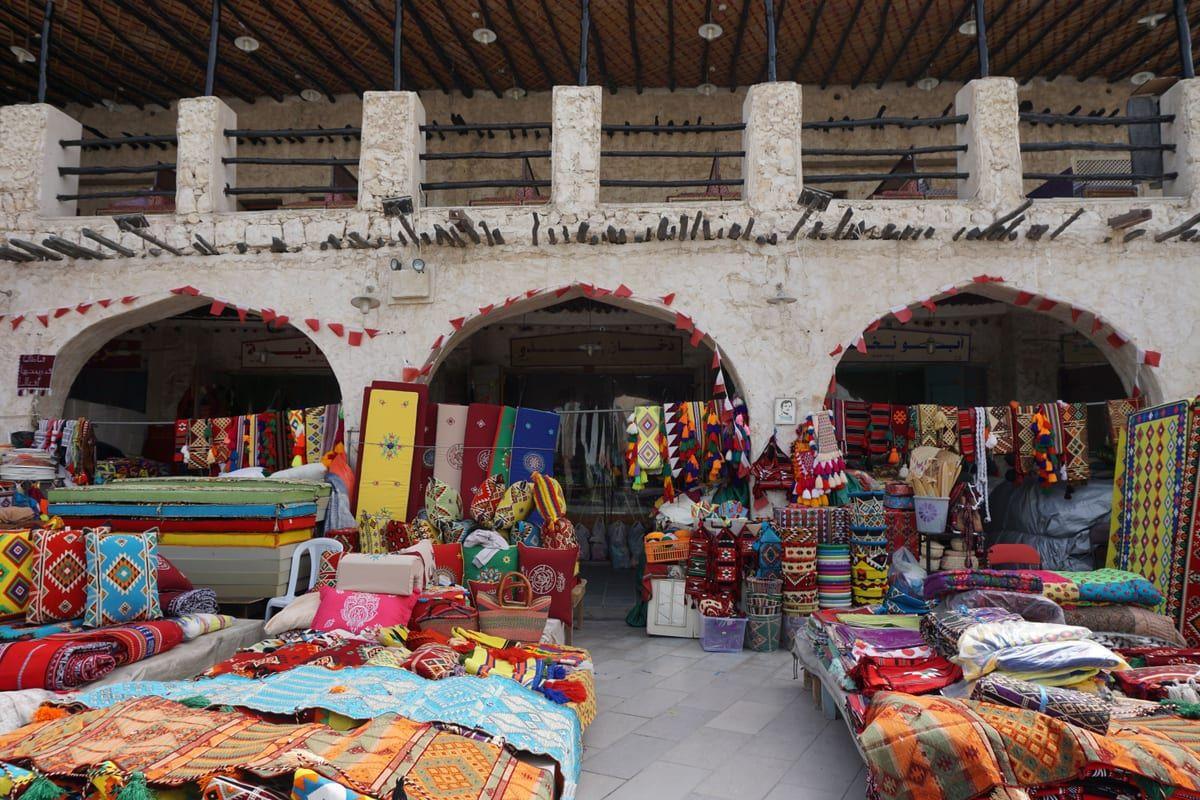
Nothing reflects our commitment to local more directly than where our fabric comes from. By default, every material is handpicked in person from Doha's fabric market around Souq Waqif. We walk the stalls, feel the weight and drape, and choose by hand — which keeps our spending with local merchants and means you can see and touch your options in person during a consultation.
For the rare commission that calls for a textile the local market simply doesn't carry — a particular heritage weave or specialist embroidery — we can source from abroad on request. But that's the exception, not the headline. Local is always where we begin. (We go deeper into how this works in our piece on fabric shopping in Doha.)
Working in the Spirit of Qatar National Vision 2030
Qatar National Vision 2030 sets out a future built on four pillars — economic, social, human, and environmental development — including a more diversified economy beyond hydrocarbons, a thriving private sector, empowered local talent, and responsible stewardship of resources. A single design studio can't deliver a national vision. But it can live by its spirit, and we try to in concrete ways:
- Economic diversification. Every piece we make supports non-oil, homegrown enterprise — a small contribution to a private sector the Vision wants to see flourish, and direct support for the Souq merchants who supply us.
- Human and social development. Lavender is a women-led small business that builds and sustains local design and tailoring skills, creating space for craft to grow in Qatar rather than be imported wholesale.
- Environmental responsibility. We hold no bulk stock and run no discount rack. We stitch only what is ordered, which means zero surplus and zero waste — and sourcing locally cuts the footprint of long shipping routes. Sustainability isn't a campaign for us; it's simply how the studio is built.
None of this is grand. It's the accumulation of small, deliberate choices — and that, ultimately, is how a vision becomes real.
A Choice That Stays Close to Home
When you choose a local studio, you get a better-fitting, longer-lasting garment — and you keep craft, money, and creativity within your own community. That's the quiet power of buying close to home.
If that's a story you'd like to be part of, come and start a piece with us. Explore what we create, or book a free consultation — no pressure, just a conversation about something made here, for you.
Frequently Asked Questions
- Why does supporting local fashion matter in Qatar?
- Supporting local fashion keeps money circulating within Qatar's economy, sustains the fabric merchants and artisans of the Souq, and helps homegrown design talent grow. Instead of value leaving the country through imported fast fashion, it stays in the community — supporting small businesses, creating skilled work, and strengthening Qatar's own creative industries.
- Where is Lavender Fashions based?
- Lavender Fashions is a custom design and tailoring studio in Doha, Qatar, based at the Dalla Building on Salwa Road. It was founded in 2015 and works by appointment, designing and making every piece to measure for clients across Qatar and the wider Gulf.
- Where does Lavender Fashions source its fabric?
- By default, we handpick fabric in person from Doha's Souq — the fabric market around Souq Waqif — which supports local merchants and lets us choose every material by hand. For rare textiles the local market doesn't carry, we can source from abroad on request, but local is always our starting point.
- How does Lavender Fashions contribute to Qatar National Vision 2030?
- We work in the spirit of Qatar National Vision 2030 in small but real ways: by supporting local merchants and a diversified, non-oil economy, by operating a women-led small business that builds local skills, and by making clothes only to order — zero stock, zero waste — which reflects the Vision's environmental goals.
- Is buying custom-made clothing locally more sustainable?
- Yes. A local studio that makes only what is ordered produces no surplus stock and no discount-rack waste. Sourcing fabric locally also cuts the footprint of long shipping routes, and a well-made garment is worn for years rather than discarded after a season.
Ready to dress the part?
WhatsApp Us with Your Idea
Send a reference photo, a screenshot of this article, or just a description of what you want. Free consultation, no pressure, personal reply.
WhatsApp Us